My love for the Cederberg mountains
The bar in the middle of the campsite was a wooden shack nestled among the boulders. A bright neon sign at the door spelled out the name of the establishment, glowing red capitalised letters eagerly pronouncing its presence.
Wooden benches lined the four walls. A fire in the center of the room raged stubbornly against the cold spring air. It was off-peak season and the place was almost empty. The bartender, a middle-aged man with a bulging middle, waved us in.
“Hello! First time in Cederberg?”
I shook my head.
“Where are you from?”
Malaysia.
He raised his eyebrows. “Long way to come just to visit Cederberg,” he said. “This place is magical eh… You have the stars and the fynbos in the mountains and the boulders out here. There are more flower species here than in the whole of the UK, can you believe it? Come, what can I get you?”
We were here to boulder for a few days and had set ourselves a “no-alcohol before sunset” policy to be in best form the next day. We explained all these to the man and a disappointed look crossed his face. Undeterred, he placed a bottle of benign-looking juice in a clear glass bottle on the counter.
“On the house. Locally grown and fermented passion fruit. 30% alcohol.” He winked and brought out two shot glasses. “No one has ever said no to this. I’ll take a shot with you. Chew the pits, they’re the best part.”
That’s the thing about South Africans - arbitrarily-set rules don’t matter, you can smile and charm your way out of most things. What matters is that we are all happy, lekker. I downed the shot; home had never tasted so sweet and warm.
Cederberg is a mountain range in South Africa about 50 kilometers long and located three hours north of Cape Town. It is named after the endangered Clanwilliam cedar tree, a species endemic to the area. Cederberg is also home to Rocklands, aptly named for its vast fields of natural sandstone boulders - a climber’s paradise.
I have driven here twice for day hikes back when I worked in Cape Town a few years ago. This place holds a personal significance: I had fallen in and then out of love in these rocky mountains. There is not much out here in Cederberg – fynbos vegetation, farmlands in the fertile valleys, and a few campsites scattered around as bases for hikes into the mountains – but there is warmth and peace in the wilderness and solitude.
Not more than a few days ago, three friends and I had traveled to Cederberg again (this time, all the way from Malaysia) to do an overnight hike to climb Sneeuberg peak, the highest summit in the range. At the trailhead, with backpacks strapped to our waists and faces slathered in sunscreen, one of them took a selfie of us and posted it on his Insta story captioned “#offthegrid”. For twenty-four hours to the world (or his 300 followers), we were fresh faces and bright smiles standing in front of a beaten grey car. Words of encouragement and smiling emoticons promptly trickled in. We did not see the messages until days later, and even then, he merely responded “thanks it was awesome!”. Adventures of the sort we went on are not easily distilled into words; they leave lasting impressions which we carry even years after we are back home. Behind the short response were more stories untold: an unknown animal had bitten off a corner of our map when we were not looking, a friend had busted his knee and had to limp all the way down and at some point, we were actually worried about running out of food.
We did not actually reach the summit of Sneeuberg on this trip. We had a pleasant hike to the base but very quickly lost the trail while on the mountain. Cairns continued to guide us upward but about 200 meters from the top, even they disappeared into a vertical scramble up rocky knobs of snow. We were six hours in and it was getting late. We decided this would be the end of our quest to the summit.
On the ledge, we were treated to a grand vista of layers and layers of rolling mountains gently dipping into a valley which then met the clear blue sky in the horizon. From here, we could see the flat top of Table Mountain back in Cape Town, some 700 kilometers away. The golden autumn colors around us were punctuated by pink bulbous proteas, bright yellow daisy-like flowers and clumps of tiny purple petals peeking at us from beneath rocks. This was a view worth sharing on Instagram (the narcissistic tendrils of Instagram has its roots even in the remotest corners of the world), the magnificence of it all is what we meant when we say we miss South Africa. Except we couldn’t share it, and it really didn’t matter. All connections to civilization severed, we could climb trees, take naps bathed in sunlight, drink from the river, eat chocolate for breakfast, lunch, dinner if we wanted to. Heck, we could eat whatever and whenever we wanted (which was how we ran out of food).
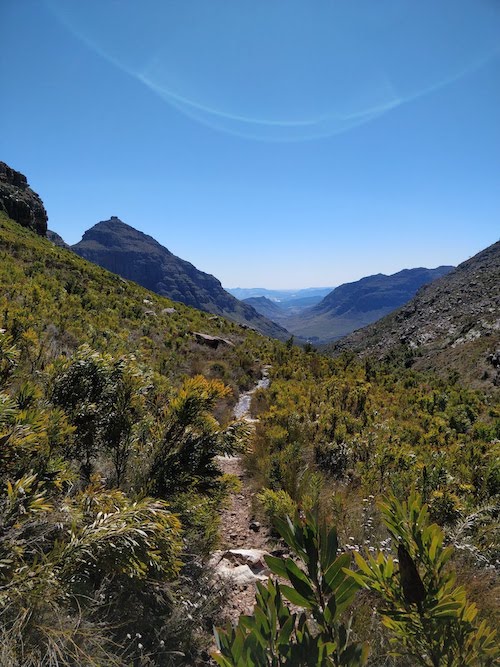
Up here, we were suspended somewhere between heaven and earth, free from the constant demand of the material world but at the mercy of the whims of the natural world. As we waddled down, the clouds rolled in and the wind seemed to blow harder. The mountain was beginning to lose its charm; the creeping darkness and cold gradually reared its ugly head as the sun set.
An hour later, and no sign of the hut we were supposed to stay in. The huge boulders in the distant horizon gradually morphed to resemble different possible shapes and sizes of shelter.
“There’s a river near the hut, right?” I asked, looking at my almost empty bottle.
“Oh. I think so.” A slight pause. Water, the most basic foundation of life, had never seemed so precious.
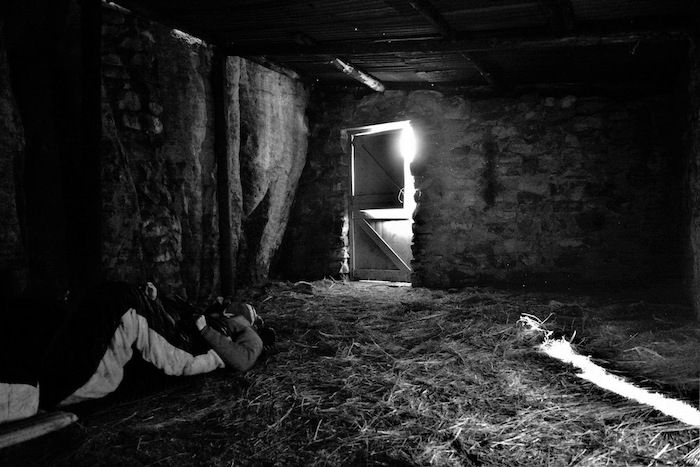
The gods who reigned over the mountains were generous that evening, and we soon spotted the silhouette of a hut in the backdrop. I half-ran towards it and my heart sank. My zen bubble, now held together only by a fragile thread of knowing we had found shelter, was burst by the unmistakable high-pitched giggle of teenagers. We arrived at a hut, which must have been a stable in the old days, packed with a group of ten or so high school students. They had come from another trail on a school trip. Their chaperone avoided our eyes as we trudged into the hut.
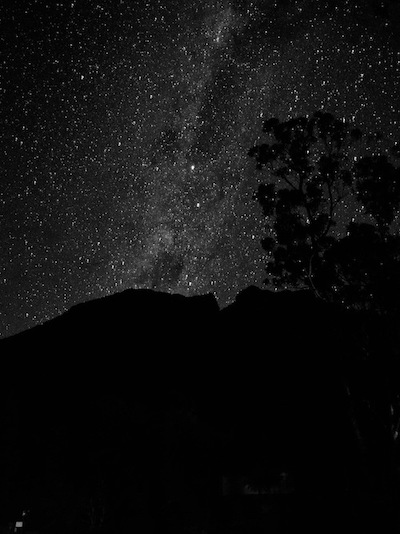
As the high-schoolers jostled and hushed each other, four of us crept outside and surreptitiously fueled up on wine while waiting for the pasta to cook (swapping out the jar of pasta sauce for wine in my backpack was one of my best decisions on this trip). Huddled in our jackets, between mouthfuls of cold pasta mixed with black pepper, we craned our necks up at the night sky. There was Mars, a defiant red among its twinkling peers. Jupiter shone proudly low in the horizon and the Milky Way, a bright silver band against the pitch-black, lit up the sky. The dark sky was a blank canvas on which the sketches of stars, planets, and meteors were now visible to our human eye. Our ancestors looked up at them and saw practical navigation tools. Galileo through his telescope saw that the Sun (not Earth, not us) was the center of the universe. Hubble saw other galaxies in a constantly expanding universe.
I looked up and saw a dark abyss, a dizzying gap in my understanding of the universe and of the reason for our existence. Confronted by the immensity of the question “why?”, Hamlet poses two options: to be or not to be. Look life in the eye, see it for what it is, and choose either to reject or live it with love.
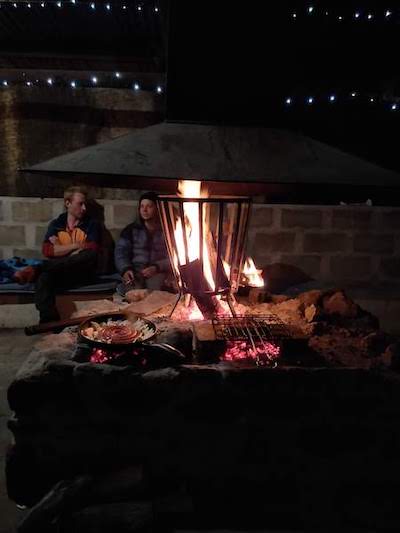
The next few days in Rocklands, life took on a different hue. The reddish-sandstone boulders were our playground, and we were free, humbled and curious. There was no rule: we climbed routes with interesting names, such as “The Girlfriend Problem” which our friend could not send and declared remains an unsolved mystery, and picked boulders we thought were aesthetically pleasing. We took naps on the boulders in the warmth of the sun. And night after night we returned to the bar, braai-ing broewors (South African sausages) over the campfire and continuing our evening with wine-fueled nights. Climbers congregated here, exchanging beta on classic routes and recalling narrow misses or big falls, the burning passion in their eyes a reflection of the fire blazing in the room. It was almost like we were a cult of boulder worshippers, mere mortals whose goal in life was to repeat the classic routes established by the pro climbers with seemingly divine strength.
On one of these nights, I saw a shooting star. It was fleeting, gone so fast I doubted my vision but it was there. There I stood, in awe, tipsy, and feeling ridiculously happy. The Greek astronomer, Ptolemy, believed that shooting stars fell out a slit which sometimes, out of curiosity or boredom, God uses to peer through the black spheres on Earth. I believed they were magical; to have seen one while surrounded by huge rocky peaks with the faint sound of laughter and warm conversations in the background was a small gesture of the universe that the right choice is to live and love life.
On our last day, we packed up with a heavy heart. After staring at Google Maps for what seemed like an hour, a friend looked up from his phone and suggested we take a much longer jeep road through the mountains on the opposite side of the Cederberg range. We might get good views, he proposed.
We consulted the guy at the campsite office. He looked at our rented hatchback, so sand-dusted and whipped they should use it in an advertisement to upsell car rental insurance. His eyes narrowed.
“Your clearance is too low. There is this steep rocky section here which might be tricky,” he made about a three-inch gap between his thumb and index finger and glanced at the car again. “It’s not too long but most people use 4x4s. But you know, go for it, you climbers have nerves of steel… Do you have a car jack and a spare tyre?”
I deliberated. On this route, the drive back to Cape Town would take three times longer, the road was not marked clearly anywhere on the map, and our car could get stuck on a steep gravel road. It might take forever to get assistance.
Yet despite all that, there was a gnawing feeling… “Yeah, let’s do it.”